PROGRESSIVE MUSCLE RELAXATION (PMR) by Fernando Rosete, MS, CSCS, USAW
This technique has been proven to reduce stress, anxiety, physiological arousal, and decrease cortisol levels, while supporting empathy development and supporting recovery.
Progressive muscle rel0061ation (PMR) is a process that includes a series of muscle contractions followed by relaxation, while practicing mindful diaphragmic breathing.
1. Place yourself on comfortable position, seating or lying down on your back. Take your shoes off.
2. Close your eyes and start by focusing on your breathing. Take long inhalations (4-5 seconds) ensuring your abdominal section elevates and not your chest. This ensures you are using your diaphragm to breathe. Follow with a long exhalation (5-7 seconds). Continue this process until it starts feeling more natural.
3. Start PMR from lower body to upper body. The first step requires a strong muscle contraction on a specific body region (hold for 4-5 seconds). The second step involves the quick relaxation of the same muscles that were previously contracted as you continue practicing mindful breathing. You should feel those muscles loose as tension decreases. Continue to focus on the relaxation for about 15 seconds before moving on to the next body region.
The main goal of this exercise is to focus on the distinction between tension and relaxation while being present to your breathing. While focusing on the relaxation, be mindful of the tension leaving the body region like flowing water.
It is recommended to record your voice or have someone with a soothing voice record the steps for you to follow. You could use the following message:
Take a deep breath in through your nose…hold your breath for a few seconds…and now breathe out…take another deep breath through your nose… Now pay attention to your body and how it feels…. Start with your feet and calves… curl your toes as you contract your calf muscles. Curl your toes as tight as you can, now hold it….hold it…good…now relax and exhale…let your feet and calves go limp…notice the difference between the tension and relaxation….feel the tension flow out of your feet and calves like water…(then repeat with shins and thighs, etc.…)
You can follow this order when practicing your PMR from lower to upper body:
A) Feet and calves (curl your toes as you contract your calf muscles)
B) Shins and thighs (Flex your shin muscles by lifting your feet towards your knees)
C) Glutes and hamstrings (squeeze your butt and back of the legs)
D) Abdominals (as you exhale, draw in your belly button towards your spine)
E) Back arms and forearms (Make a strong fist, extend your arms while you flex your triceps and squeeze your shoulder blades together)
F) Chest, neck and face (Flex your chest and neck muscles, while closing your eyes very tightly and flexing as many face muscles as you can)
Here you have links for a couple of guided exercises, if you prefer:
Guided PMR male voice: https://youtu.be/1nZEdqcGVzo
Guided PMR female voice: https://youtu.be/86HUcX8ZtAk
Reference:
Rausch, S.M., Gramling, S.E., and Auerbach, S.M. (2006). Effects of a Single Session of Large-Group Meditation and Progressive Muscle Relaxation Training on Stress Reduction, Reactivity, and Recovery. International Journal of Stress Management Copyright 2006 by the American Psychological Association; Vol. 13, No. 3, 273–290.
SCIENCE PROVES LAVENDER OIL EFFECTIVE IN STRESS MANAGEMENT by Fernando Rosete, MS, CSCS, USAW
Stress management is vital to maintain psychological readiness for operational effectiveness. Stress has been found as an important contributor to erratic judgement or/and performance. Hence, the importance of counting on stress management techniques and additional supportive resources, considered highly valuable as part of an airman’s mental readiness “toolbox” (Thompson & McCray, 2006).
Regardless of your current, individual level of psychological training for stress management and mental resiliency, the usage of external factors would make an easy addition to your mental readiness toolbox. In particular, the use of aromatherapy has been proven effective reducing perceived and physiological stress. Aromatherapy could be beneficial for your whole family.
During a scientific study, Sayorwan, et al. (2012) found a significant impact of lavender oil aromatherapy in the following areas:
A. Stress Reduction:
A1) Decreased blood pressure
A2) Lower heart rate and skin temperature
B. Positive Mood-state Changes:
B1) Bad and drowsy feelings significantly decreased
B2) Pleasant emotions significantly increased (active, fresh and relaxed)
C. Improved, relaxed state of mind:
C1) Increased alpha and theta-wave brain activity (synonym of a relaxed state)
C2) Similar brain activity and relaxation when compared to effects of meditation
There are several essential oil makers and oil diffuser vendors, easily accessible online. Based on scientific research, lavender oil could be a great addition to your stress management toolbox, with potential benefit to your whole family. On average, it would cost about $25-30 to purchase a diffuser and lavender oil, depending on the brand and size.
References:
Sayorwan, W., et al. (2012). The Effects of Lavender Oil Inhalation on Emotional States, Autonomic Nervous System, and Brain Electrical Activity. Journal of the Medical Association of Thailand, Vol. 95, 4.
Thompson, M. M., & McCreary, D. R. (2006). Enhancing Mental Readiness in Military Personnel. Operational Stress. Military life: The psychology of serving in peace and combat: Operational stress (p. 54–79). Praeger Security International.
MINDFUL MEDITATION FOR STRESS MANAGEMENT & RESILIENCY by Fernando Rosete, MS, CSCS, USAW
Stress injury could be the result of a single traumatic event, as well as the result of an on-going, chronically elevated hormone levels that cause our nervous system to be in a state of constant alert (Thomas & Taylor, 2015). The current circumstances cause stress in all of us and our families and it is our responsibility to manage that, individually and collectively, as the team we are.
There is a myriad of stress management techniques available for immediate use. Meditation is a free, simple, practical, and effective practice that could be implemented individually or as a group. Meditation is a form of mental training, specific to improve attentional and emotional self-regulation, and self-awareness (Tang, Holzel, Posner., 2015). There are many different types of meditation practices. Mindful meditation is recognized as non-judgmental attention to present moment experiences. The regular practice of mindful meditation has proven effective creating behavior modification, changes in brain activity and brain structure (Tang, Holzel, Posner., 2015). All those changes are key when forming protective personality traits, basic to promote growth and resiliency.
In the military, mindfulness-based stress reduction (MBSR) has been widely used with positive results. Mindfulness training supports our ability to regulate the nervous system and calm our body’s fear receptors and has been recognized as an effective stress and anxiety reductor, pre- and post-deployment (Thomas & Taylor, 2015). Ryan (2012) describes mindfulness training to “bulletproof” your brain, creating more effective warriors with mental endurance, key for optimal combat readiness. Jha et al. (2010) found that improvement on stress regulation allowed study participants to bond while increasing working memory and cognitive control.
During a study on mindfulness pre-deployment training on marine reservists, Stanley, Schaldach, Kiyonaga, and Jha (2011) assessed changes in self-reported mindfulness practice and perceived stress, before and after a mindfulness course. The study proved individuals who reported a greater amount of mindfulness practice scored higher in perceived mood, and lower in stress perception, developing skills aligned with mental resiliency. At group level, leaders and team members noted improvements in unit cohesion and communication. Leaders also reported a greater ability to recognize emotions in themselves and others, as well as increased self-knowledge. Team members reported an increased ability to recognize personal strengths and weaknesses, identify “warning signs” for stress, maintaining a healthy emotional baseline.
Conclusion
MBSR is a non-complicated technique, readily accessible for everyone, including kids and older adults. Mindfulness meditation should be considered regular practice for stress management improvement, self-awareness, mood control and overall health and wellness enhancement.
Just like any type of skill, meditation requires regular practice to create adaptations and improvements and it could be challenging at the beginning. Notwithstanding, it is a great technique to develop self-compassion and mental discipline, important markers of resiliency.
Please consider the following guided exercises for your practice and share with your family and friends. I suggest you try them all and choose your favorite for regular practice. We all can benefit from stress management development these days!
MSBR Lake Meditation: https://youtu.be/3DoIOHb0unE
MSBR Mountain Meditation: https://youtu.be/9SwnJ6kqpa0
Mindfulness Meditation: https://youtu.be/6p_yaNFSYao
Mindfulness Meditation for Kids: https://youtu.be/VZ_wdeog5Ek
References:
Jha, A. P., Stanley, E. A., Kiyonaga, A., Wong, L., & Gelfand, L. (2010). Examining the protective effects of mindfulness training on working memory capacity and affective experience. Emotion, 10(1), 54-64.
Ryan, T. (2012). A mindful nation: How a simple practice can help us reduce stress, improve performance, and recapture the American spirit. Carlsbad, CA: Hay House.
Tang, Yi-Yuan & Holzel, Britta & Posner, Michael. (2015). The neuroscience of mindfulness meditation. Nature Reviews Neuroscience. 16. 10.1038/nrn3916.
Thomas, K.H., Taylor, S.P. (2015). Bulletproofing the Psyche: Mindfulness Interventions in the Training Environment to Improve Resilience in the Military and Veteran Communities. Advances in Social Work Vol. 16 No. 2.
PHYSICAL TRAINING (PT): NO PAIN, NO GAIN? by Fernando Rosete, MS, CSCS, USAW
Is the old saying “no pain no gain” legitimate? To certain extent, it is. But we must be smart about it. Our body is a biological machine which adapts to stressors and the environment. Our daily lifestyle determines what our body “learns.” Every time there is a stimulus of any kind, our body reacts accordingly. When that stimulus is presented again and again, the biological machine learns, adapts and most of the time overcomes.
Physical training (PT) involves regular, ongoing exposure to metabolic, thermoregulatory, hypoxic, oxidative, and mechanical stress. Such stimuli trigger compensatory physiological adaptations that simply increase our tolerance to subsequent PT sessions. Obviously, that is the main goal of regular exercise and such adaptations are the foundation of the protective mechanisms against disease (1).
Hormesis is a process that explains how in order to create a new adaptation, a stimulus must be present. After that, the system requires time to recover from the stress of the stimulus and later, there is a supercompensation that will allow for an adaptation to take place. However, low exposure or too high exposure to stress could be detrimental, while moderate exposure is beneficial and necessary (1). For example, endurance exercise depletes glycogen (sugar in our body, used as fuel) and increases core temperature. In response, our body increases glycogen storage and improves thermoregulation. In contrast, excessive PT could cause chronic depletion of glycogen and excessive heat-stress and overtraining syndrome (2). That is why PT sessions should be programmed in a periodized, well organized manner. Managing training volume is key for successful adaptations.
When it comes to exercise adaptations, such as muscle growth, strength gains, power development, speed, agility, aerobic capacity, there is a simple explanation of how we adapt to exercise:
1. We exercise, placing stress on our body. This stress creates an alarm reaction, followed by many recovery mechanisms.
2. As we allow our body to rest and follow proper recovery protocols, we enable our body to get ready for the next session.
3. Overtime, as PT, followed by proper recovery is regular practice, our body learns and there is a supercompensation reaction, as our body gets “ready” for the demands of the exercise.
4. We take advantage of the training gains!
It is key to maintain PT sessions consistent, including strength and cardiovascular modalities, as well as emphasize on recovery protocols, including proper nutrition and sleep to prevent overtraining and support maximum adaptations. If you are not participating on a PT program, please contact me so we could figure out together what is the best option for your case.
References:
1. Merry, Troy & Ristow, Michael. (2015). Mitohormesis in exercise training. Free Radical Biology and Medicine. 98. 10.1016/j.freeradbiomed.2015.11.032.
2. Snyder, A.C. (1998). Overtraining and glycogen depletion hypothesis. Med.Sci.Sport. Exerc. 30 (7), 1146–1150.
WHY IS HIGH INTENSITY TRAINING SUPERIOR? by Fernando Rosete, MS, CSCS, USAW
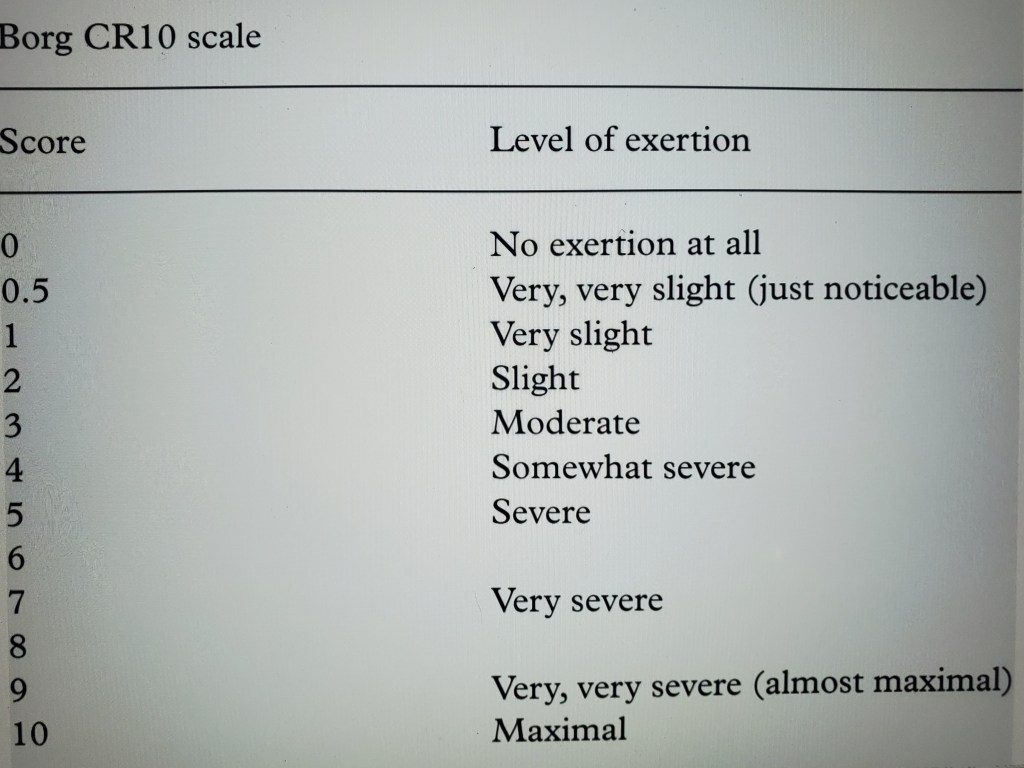
High intensity training has always proven as the most beneficial type of exercise. But what does high intensity really mean? In simple terms, high intensity is easily determined by your rate of perceived exertion (RPE). RPE could be considered during any type of exercise do determine intensity. The Borg’s CR10 scale simply considers RPE from 0 to 10, where 10 is considered the hardest (4). Regardless of training modality (aerobic, weight training, metabolic) high intensity is considered as a 7 or higher RPE, in accordance with the following figure (4).
An effective and efficient way to train combines the proved benefits of high intensity interval training (HIIT) and resistance training (RT) in a functional manner, to maximize benefits in the minimum amount of time. When comparing three different training modalities: HIIT, RT and the combination of both (combined training), the best results have been obtained through combined training (1). All our programs follow a combined training protocol, designed as the most efficient and effective way to maximize fitness, in support to strength, conditioning and overall readiness. Nevertheless, the order, sequence and type of exercises during each session must be rationalized. All our programs have been designed based on scientific findings.
Regular participation in a PT program will promote the following adaptations:
Increased energy. – As training spikes growth hormone (key for muscle development) and promotes an increase in neurotrophic factors that support brain cell function (1).
Minimize pain. – As your body composition and mobility improve, reducing stress in joints that could potentially cause pain. Correct muscle imbalances and avoid lower back pain, shoulder and neck discomfort or other conditions (3).
Better quality of sleep. – A reduced sleep latency, and sleep medication usage, through an increased energy consumption and endorphins secretion via exercise, controlling possible health adverse outcomes (5).
Enhanced mobility and reduced injuries. – As you improve flexibility allowing for increased range of motion and controlled stress on joints (2).
Improved cardio. – Boost your cardiovascular capacity (VO2max), for better health and functionality. Increase muscle mass, reduce cholesterol, triglycerides and insulin resistance for diabetes prevention, as your metabolic function becomes more efficient and effective (1).
Be more active. – As your strength levels increase through resistance training exercises, which simultaneously promote an increase in nitric oxide, allowing for better circulation and reducing resting blood pressure and cardiac stress (3).
Improved body composition. – With a combined training protocol that allows you to burn more calories during training and heighten your body fat burning capacity after exercise (3).
Increase your career length capacity and longevity. – As you could reverse cellular deterioration (3), preventing muscle mass loss (sarcopenia), increase muscle tone while upgrading aerobic and anaerobic energy systems for improved overall health and fitness status.
Upgraded nutrition. – As you start feeling more fit and energetic, your metabolism is improving. This process will make it easier to support proper eating habits to maintain that status.
Every strength program has been designed with undulating periodization. That is, week 1 is a base week, then intensity increases gradually on week 2, and decreases on week 3. The last week of every cycle is considered a high-performance week, as intensity increases again. After week 4 a new cycle starts again. Undulating periodization has proven the most effective, including when training tactical athletes.
If you are not sure which program to choose, or have any questions, please reach out so we could define the best option for you.
Cheers,
Coach Fernando
References:
1. Domínguez-Sanchéz, M., Bustos-Cruz, R.H., Velasco-Orjuela, G.P., et al. (2018). Acute Effects of High Intensity Resistance, or Combined Protocol on the Increase of Level of Neurotrophic Factors in Physically Inactive Overweight Adults: The BrainFit Study. Frontiers in Physiology. 9:741.
2. Morton, S. K., Whitehead, J.R., Brinkert, R.H., Caine, D.J. (2011). Resistance Training vs. Static Stretching: Effects on Flexibility and Strength. Journal of Strength and Conditioning Research, 0(0)/1–8.
3. Wescott, W.L. (2012). Resistance Training is Medicine: Effects of Strength Training on Health. American College of Sports Medicine, 11,4.
4. Williams, N. (2017). The Borg Rating of Perceived Exertion (RPE) scale, Occupational Medicine, Volume 67, Issue 5, July 2017, Pages 404–405.
5. Yang, P-Y., Ho, K-H, Chen, H-C, Chien, M-Y (2012). Exercise training improves sleep quality in middle-aged and older adults with sleep problems: a systematic review
THE WHEEL OF LIFE: A WELLNESS EXERCISE
PT EFFECTS ON BRAIN HEALTH
The rhythm and demands of modern life have many detrimental effects on our body and brain. Stress, anxiety and depression are the most common psychiatric conditions that affect millions of individuals of all ages in the United States (2). Aerobic and strength exercises have a positive impact on our body as much as our brain. Epidemiological studies across Europe and America have found individuals who are physically active are less prone to incurring into mental health problems in comparison to sedentary people (2). Exercise has protective effects against anxiety and stress, improves cognitive function, and has similar effects to anti-depressant medication (1, 2). Exercise has also been beneficial on the treatment of post-traumatic stress disorder (PTSD), obsessive compulsive disorder (OCD), general anxiety disorder (GAD), and other conditions.In today’s life, we are all exposed to a myriad of stressors. Keeping our brain/mind healthy is as important as maintaining a healthy body. Our participation on a regular training program, at least 3 days per week, designed with the proper combination of aerobic and anaerobic exercises will offer you the greatest benefits for body and mind.If you are not currently participating on a professionally designed and periodized program, please contact me. We will discuss your goals and determine what is the best program based on your needs, goals and equipment access.
Cheers, Fernando
References:
1. Asmundson, G.J.D., Fetzner, M.G., DeBoer, L.B., Powers, M.B., Otto, M.W., Smits, J.A. (2013). Let’s get physical: A contemporary review of the anxiolytic effects of exercise for anxiety and its disorders. Depression and Anxiety; 30:362–373.
2. Carek, P.J., Laibstain, S.E., Carek, S.M. (2011). Exercise for the treatment of depression and anxiety. International Journal of Psychiatry in Medicine; Vol. 41(1) 15-28.
 Applied Exercise Science