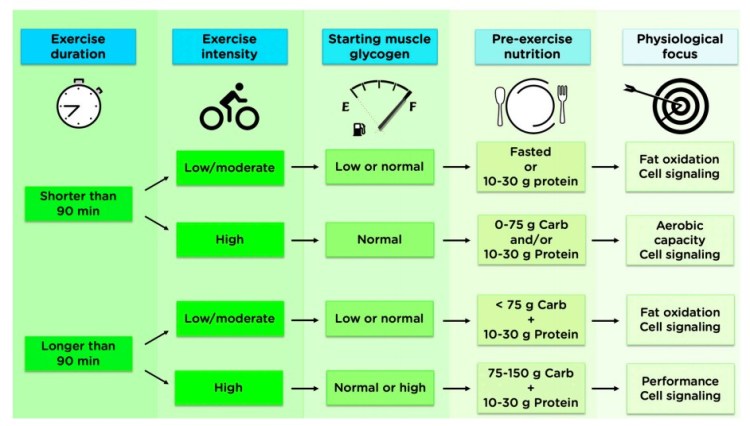
There has been extensive research and a myriad of opinions about this subject, resulting on confusion for the general public. The duration and intensity of an exercise session dictate what would be ideal to eat before exercising.
Some common strategies include exercising in overnight-fasting mode, carbohydrate restrictions between training sessions, and increasing carbohydrate consumption before or during exercise. Scientific research results present mixed results, but we could consider the following facts to be persistent:
- Our liver plays an important role in exercise metabolism, especially because we store glycogen in it. During an overnight fast, liver glycogen (sugar necessary for work) levels are reduced by about 40%, while a decrease in glucose utilization in muscles during exercise has been observed. Nevertheless, fatigue during extensive exercise is associated with low levels of blood glucose.
- Exercising in a fast state could increase fat oxidation, but when exercise is intense, the impact on performance could be detrimental.
- Perception is reality: The notion of having breakfast (or not) before exercise, has shown changes in performance based on personal perception.
In conclusion, the importance of eating carbohydrates before training depends on the exercise intensity and duration, while exercising in fasted or fed mode seems to have a more important impact on performance than the size or timing of the meal.
This article was written for general information purposes. For detailed/personalized nutrition guidelines, please consult a registered dietician.
References:
Rothschild, J. A., Kilding, A. E., & Plews, D. J. (2020). What Should I Eat before Exercise? Pre-Exercise Nutrition and the Response to Endurance Exercise: Current Prospective and Future Directions. Nutrients, 12(11), 3473.
 Applied Exercise Science