
Eccentric exercises have been used extensively and are known for their great benefits for strength gains and muscle development. Eccentric exercises are commonly known as “negatives” as the emphasis is on controlling the resistance while the muscle is lengthening. For example, the eccentric portion of a bench press is when the weight is being lowered towards the chest, as chest and triceps muscles are lengthening.
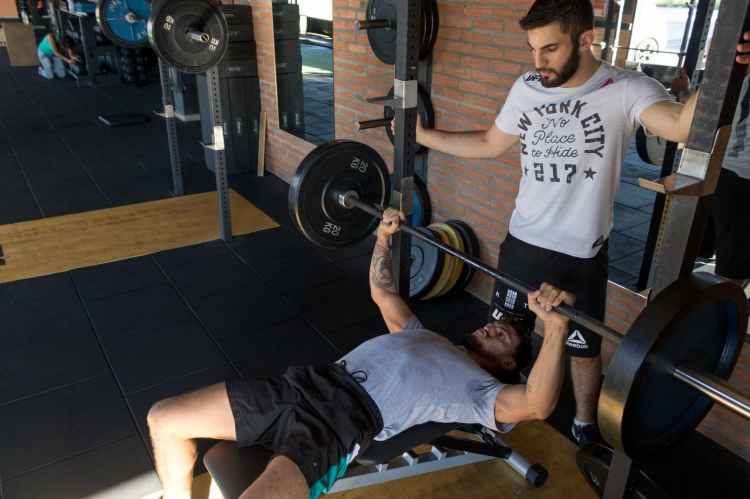
How does eccentric work?
Eccentric work capacity is greater than concentric. During eccentric, muscle is lengthening under tension. That process takes advantage of the elastic properties of tendons, and muscle cell proteins, that literally work like a spring (titin). The energy requirements of eccentric muscle actions are considerably lower to those of concentric (muscle shortening/contraction). In other words, eccentric is more efficient than concentric action. In addition, it has been recorded that after a detraining period, strength is maintained for longer time after eccentric training (3).
Hormonal responses after exercise are key for the promotion of strength and hypertrophy. Eccentric work promotes an increase on growth hormone (GH), which enhances testosterone production, key for muscle development (1,4).
At what velocity is eccentric training most beneficial?
Eccentric exercise benefits include a higher production of GH, when compared to traditional training. It has been noticed that increases in GH are higher after slow eccentric training (3 seconds eccentric), in comparison to traditional training (.5 seconds eccentric). In other words, slow eccentric is more beneficial for strength and hypertrophy gains (1).
Benefits of Eccentric Training
- Lower metabolic demand= more capacity for work, less fatigue (1,3).
- Greater capacity for force production= heavier loads = possibility to develop strength gains. Taking advantage of the elastic qualities of muscle fibers, muscles can produce greater forces while lengthening, in comparison to their shortening action (concentric, or contraction) (1,3).
- Greater strength gains, when compared to traditional lifting (concentric/eccentric) (3,4).
- Strength gains are maintained for longer during a detraining period (3).
- Superior increases on muscle mass (hypertrophy), when compared to traditional lifting (1,2,3).
References:
1. Calixto, R., Verlengia, R., Crisp, A., Carvalho, T., Crepaldi, M., Pereira, A., Yamada, A., da Mota, G., & Lopes, C. (2014). Acute effects of movement velocity on blood lactate and growth hormone responses after eccentric bench press exercise in resistance-trained men. Biology of sport, 31(4), 289–294. https://doi.org/10.5604/20831862.1127287.
2. Carvalho, T & Crisp, Alex & Lopes, Charles & Crepaldi, & Calixto, R & Pereira, A & Silva, J & Yamada, André & Marchetti, Paulo & Verlengia, Rozangela. (2015). Effect of eccentric velocity on muscle damage markers after bench press exercise in resistance-trained men. Gazzetta medica italiana. 174. 1-7.
3. Coratella, Giuseppe & Schena, Federico. (2016). Eccentric resistance training increases and retains maximal strength, muscle endurance and hypertrophy in trained men. Applied Physiology, Nutrition, and Metabolism. 41. 10.1139/apnm-2016-0321.
4. Meneghel, Adilson josé & Verlengia, Rozangela & Crisp, Alex & Aoki, Marcelo & Nosaka, Kazunori & Mota, Gustavo & Lopes, Charles. (2014). Muscle damage of resistance-trained men after two bouts of eccentric bench press exercise. The Journal of Strength and Conditioning Research. 28.
 Applied Exercise Science