
As a tactical athlete (i.e., military, firefighters, specialty police personnel) you are generally expected to carry gear and equipment indispensable for protection and performance. Even though some research has shown a negative relationship between load carriage and marksmanship, training under load not only allows you to get accustomed to external loads but is highly beneficial to promote adaptations. In addition, the absence of load carriage activities during physical training (PT), may increase the risk of future workplace injury (3,4,5,7).
Performance under load
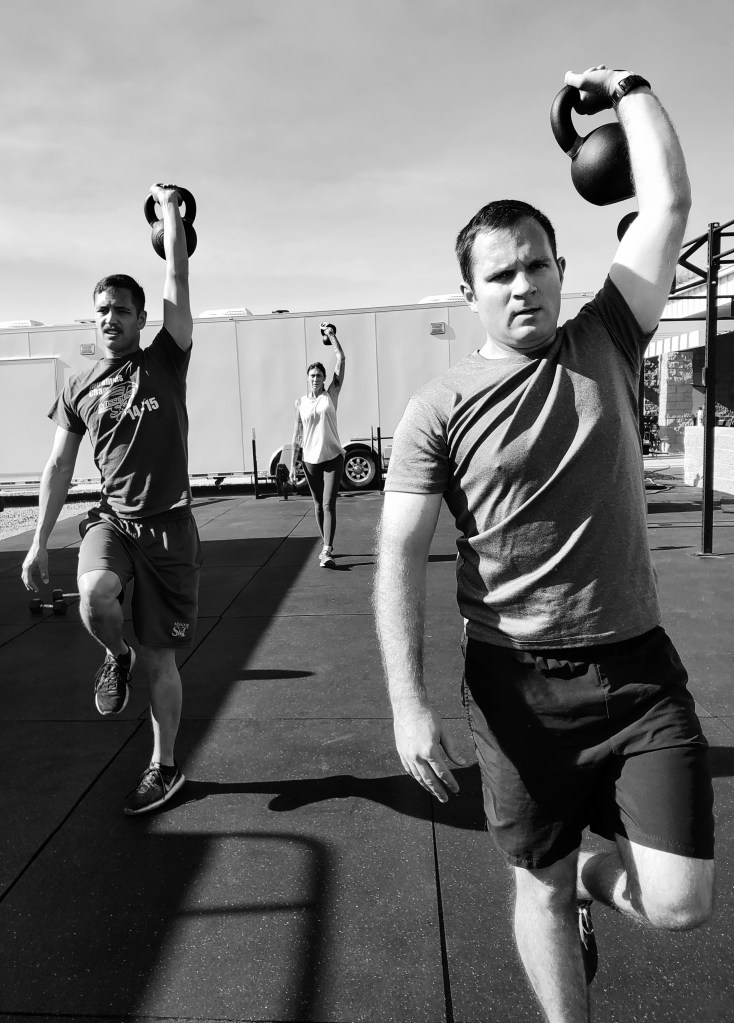
It is expected to see a limiting effect on speed and explosive movement when a tactical athlete is under load (fighting load, weapon, helmet, and combat body armor), compared to just uniform and boots. During an experiment, loaded and unloaded conditions were compared as soldiers sprinted 30m. Males increased their sprint time by 29% and females by 36% under load (8). For that reason, PT should include locomotion under load. During our training, we perform different carries, including overhead marches, farmer carry marches, and in other occasions, medicine ball carries on the field. Sled push and band resisted sprints are other drills we use that include locomotion underload.
Benefits of loaded carries
- Core stabilization and postural muscle strength and endurance. – For example, farmer, unilateral march (or suitcase carry), demands stabilization by hip and abdominal muscles. In addition, these carries require the engagement of back and shoulder stabilizers that promote strength and proper function of postural muscles. An overhead, single kettlebell march has similar effects, requiring more engagement of shoulder stabilization muscle activity, beneficial for injury prevention and strength (6).
- When used as a “finisher” exercise during PT, a loaded carry is a mental and physical challenge that demands endurance from spinal stabilizer muscles, key to prevent back injuries, and hip stabilizers that protect the knee (1,2).
- Loaded carries require an isometric type of muscle action. That is, even though, there is no change in length on active muscles, an ongoing, strong activation is taking place as you are promoting the strength and endurance of those important stabilizers. Carries are recommended for a duration of 30 seconds or more (1,2).
- As a “rule of thumb,” carries are recommended to be loaded accordingly, based on your specific needs (1):
- Injury prevention/rehabilitation: 50% of bodyweight, carried for 30s.
- General fitness: 100% of bodyweight, carried for 30s.
- Elite sports performance: 200% of bodyweight, carried for 30s.
Conclusion
Loaded carries are reliable exercises, recommended for any strength and conditioning program, in populations that endure external loads during work activities. As a tactical athlete, loaded carries are highly encouraged and indispensable in your PT program to prevent injuries, increase strength, endurance, and resiliency.
References:
1. Butcher, S.J. & Rusin, J.S. (2016). Core Strength and Functionality with Loaded Carries. NSCA Coach, July 2016.
2. Gonzalez, C., Lockie, R. (2020). Abdominal and Lumbo-Pelvic Stability Exercises for First Responders. TSAC Report. Vol. 55, 3.
3. Lowe, J. B., Scudamore, E. M., Johnson, S. L., Pribyslavska, V., Stevenson-Wilcoxson, M. C., Green, J. M., & O’Neal, E. K. (2016). External loading during daily living improves high intensity tasks under load. International Journal of Industrial Ergonomics, 55, 34-39.
4. Orr, R., Poke, D., Stierli, M., & Hinton, B. (2015). The perceived effect of load carriage on marksmanship in the tactical athlete. Journal of Science and Medicine in Sport, 19, e92.
5. Orr, R. (2015). Load carriage: reconditioning for the return to work of tactical athletes. Physiotherapy, 101, e1153-e1154.
6. Pope, R. (2018). TSAC—REDUCING THE RISK OF INJURY. EDUCATE. MOTIVATE. INSPIRE., 8, 24.
7. Solomonson, A. A., Dicks, N. D., Kerr, W. J., & Pettitt, R. W. (2016). Influence of load carriage on high intensity running performance estimation. The Journal of Strength & Conditioning Research, 30(5), 1391-1396.
8. Treloar, A. K. L., & Billing, D. C. (2011). Effect of load carriage on performance of an explosive, anaerobic military task. Military medicine, 176(9), 1027-1031.
 Applied Exercise Science