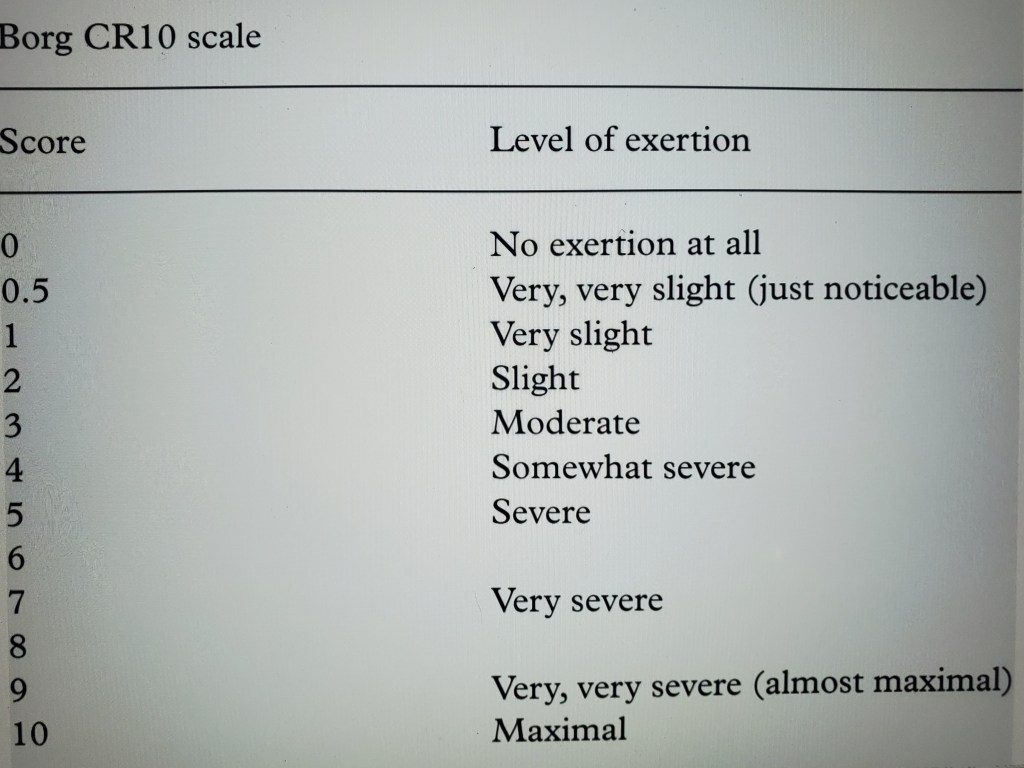
High intensity training has always proven as the most beneficial type of exercise. But what does high intensity really mean? In simple terms, high intensity is easily determined by your rate of perceived exertion (RPE). RPE could be considered during any type of exercise do determine intensity. The Borg’s CR10 scale simply considers RPE from 0 to 10, where 10 is considered the hardest (4). Regardless of training modality (aerobic, weight training, metabolic) high intensity is considered as a 7 or higher RPE, in accordance with the following figure (4).
Figure 4:
An effective and efficient way to train combines the proved benefits of high intensity interval training (HIIT) and resistance training (RT) in a functional manner, to maximize benefits in the minimum amount of time. When comparing three different training modalities: HIIT, RT and the combination of both (combined training), the best results have been obtained through combined training (1). All our programs follow a combined training protocol, designed as the most efficient and effective way to maximize fitness, in support to strength, conditioning and overall readiness. Nevertheless, the order, sequence and type of exercises during each session must be rationalized. All our programs have been designed based on scientific findings.
Regular participation in a PT program will promote the following adaptations:
Increased energy. – As training spikes growth hormone (key for muscle development) and promotes an increase in neurotrophic factors that support brain cell function (1).
Minimize pain. – As your body composition and mobility improve, reducing stress in joints that could potentially cause pain. Correct muscle imbalances and avoid lower back pain, shoulder and neck discomfort or other conditions (3).
Better quality of sleep. – A reduced sleep latency, and sleep medication usage, through an increased energy consumption and endorphins secretion via exercise, controlling possible health adverse outcomes (5).
Enhanced mobility and reduced injuries. – As you improve flexibility allowing for increased range of motion and controlled stress on joints (2).
Improved cardio. – Boost your cardiovascular capacity (VO2max), for better health and functionality. Increase muscle mass, reduce cholesterol, triglycerides and insulin resistance for diabetes prevention, as your metabolic function becomes more efficient and effective (1).
Be more active. – As your strength levels increase through resistance training exercises, which simultaneously promote an increase in nitric oxide, allowing for better circulation and reducing resting blood pressure and cardiac stress (3).
Improved body composition. – With a combined training protocol that allows you to burn more calories during training and heighten your body fat burning capacity after exercise (3).
Increase your career length capacity and longevity. – As you could reverse cellular deterioration (3), preventing muscle mass loss (sarcopenia), increase muscle tone while upgrading aerobic and anaerobic energy systems for improved overall health and fitness status.
Upgraded nutrition. – As you start feeling more fit and energetic, your metabolism is improving. This process will make it easier to support proper eating habits to maintain that status.
All our programs are designed with undulating periodization. That is, week 1 is a base week, then intensity increases gradually on week 2, and decreases on week 3. The last week of every cycle is considered a high-performance week, as intensity increases again. After week 4 a new cycle starts again. Undulating periodization has proven the most effective, when training tactical athletes.
References:
1. Domínguez-Sanchéz, M., Bustos-Cruz, R.H., Velasco-Orjuela, G.P., et al. (2018). Acute Effects of High Intensity Resistance, or Combined Protocol on the Increase of Level of Neurotrophic Factors in Physically Inactive Overweight Adults: The BrainFit Study. Frontiers in Physiology. 9:741.
2. Morton, S. K., Whitehead, J.R., Brinkert, R.H., Caine, D.J. (2011). Resistance Training vs. Static Stretching: Effects on Flexibility and Strength. Journal of Strength and Conditioning Research, 0(0)/1–8.
3. Wescott, W.L. (2012). Resistance Training is Medicine: Effects of Strength Training on Health. American College of Sports Medicine, 11,4.
4. Williams, N. (2017). The Borg Rating of Perceived Exertion (RPE) scale, Occupational Medicine, Volume 67, Issue 5, July 2017, Pages 404–405.
5. Yang, P-Y., Ho, K-H, Chen, H-C, Chien, M-Y (2012). Exercise training improves sleep quality in middle-aged and older adults with sleep problems: a systematic review.
 Applied Exercise Science